Descripción
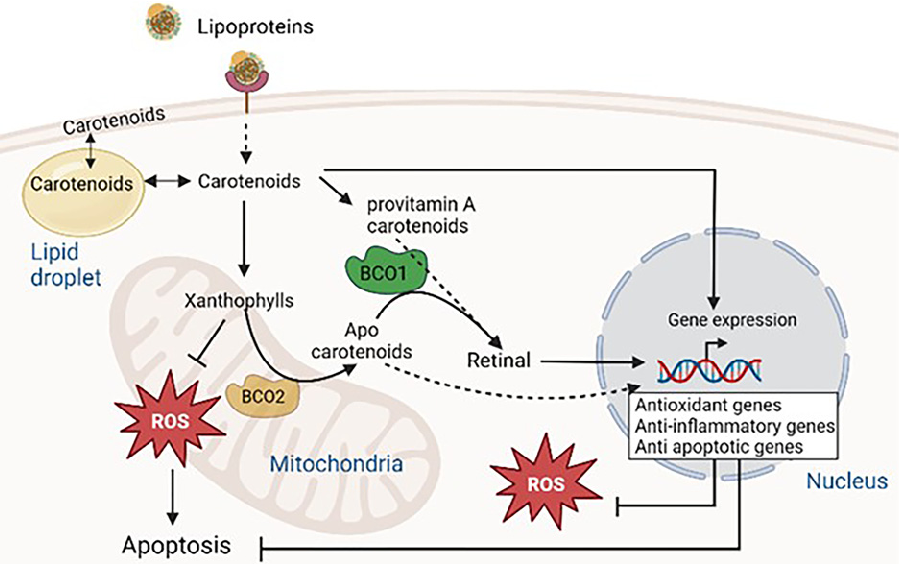
Overview of carotenoid metabolism involving BCO1 and BCO2 enzymes. Carotenoids from circulating lipoproteins enter cells through scavenger receptor class B type I, LDL receptor, and CD36, undergoing enzymatic cleavage to produce retinoids and apocarotenoids with distinct biological activities.
Figure 3
Diagram
900 × 564px
· 347,4 KB
Source Paper
Effects of carotenoids on mitochondrial dysfunction.Cite This Figure
 > Source: Opeyemi Stella Ademowo et al. "Effects of carotenoids on mitochondrial dysfunction.." *Biochemical Society transactions*, 2024. PMID: [38385583](https://pubmed.ncbi.nlm.nih.gov/38385583/)
<figure>
  <img src="https://pdfs.citedhealth.com/figures/38385583/96.png" alt="Overview of carotenoid metabolism involving BCO1 and BCO2 enzymes. Carotenoids from circulating lipoproteins enter cells through scavenger receptor class B type I, LDL receptor, and CD36, undergoing enzymatic cleavage to produce retinoids and apocarotenoids with distinct biological activities." />
  <figcaption>Figure 3. Overview of carotenoid metabolism involving BCO1 and BCO2 enzymes. Carotenoids from circulating lipoproteins enter cells through scavenger receptor class B type I, LDL receptor, and CD36, undergoing enzymatic cleavage to produce retinoids and apocarotenoids with distinct biological activities.<br>  Source: Opeyemi Stella Ademowo et al. "Effects of carotenoids on mitochondrial dysfunction.." <em>Biochemical Society transactions</em>, 2024. PMID: <a href="https://pubmed.ncbi.nlm.nih.gov/38385583/">38385583</a></figcaption>
</figure>