설명
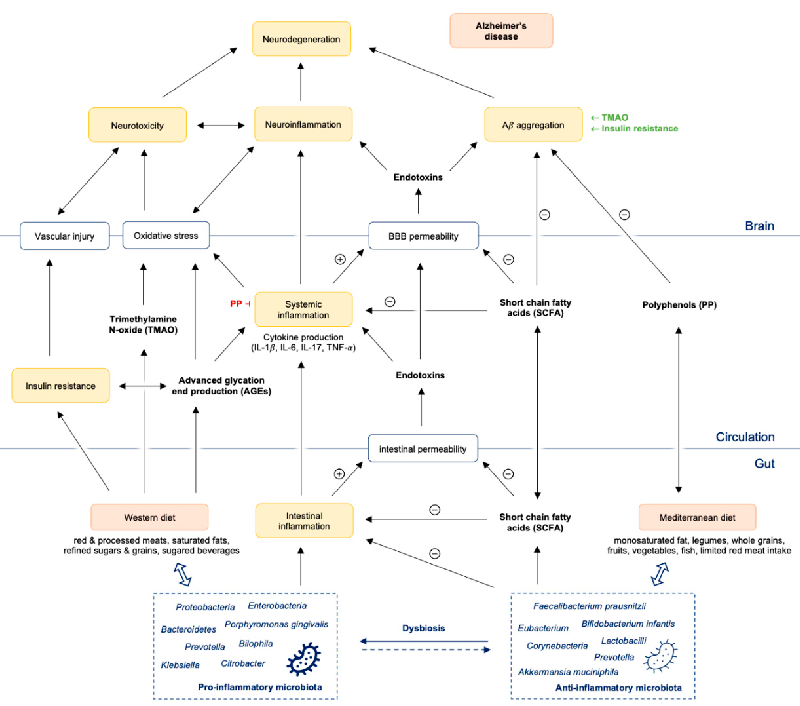
A pathway diagram illustrates how gut dysbiosis promotes intestinal and systemic inflammation, leading to amyloid-beta aggregation, neuroinflammation, and ultimately neurodegeneration in Alzheimer's disease. The cascade connects microbial imbalance to blood-brain barrier compromise and central nervous system pathology.
Figure 6
Diagram
800 × 706px
· 188.4 KB
Source Paper
The Immunopathogenesis of Alzheimer's Disease Is Related to the Composition of Gut Microbiota.Cite This Figure
 > Source: Friedrich Leblhuber et al. "The Immunopathogenesis of Alzheimer's Disease Is Related to the Composition of G." *Nutrients*, 2021. PMID: [33504065](https://pubmed.ncbi.nlm.nih.gov/33504065/)
<figure>
  <img src="https://pdfs.citedhealth.com/figures/33504065/128.png" alt="A pathway diagram illustrates how gut dysbiosis promotes intestinal and systemic inflammation, leading to amyloid-beta aggregation, neuroinflammation, and ultimately neurodegeneration in Alzheimer's disease. The cascade connects microbial imbalance to blood-brain barrier compromise and central nervous system pathology." />
  <figcaption>Figure 6. A pathway diagram illustrates how gut dysbiosis promotes intestinal and systemic inflammation, leading to amyloid-beta aggregation, neuroinflammation, and ultimately neurodegeneration in Alzheimer's disease. The cascade connects microbial imbalance to blood-brain barrier compromise and central nervous system pathology.<br>  Source: Friedrich Leblhuber et al. "The Immunopathogenesis of Alzheimer's Disease Is Related to the Composition of G." <em>Nutrients</em>, 2021. PMID: <a href="https://pubmed.ncbi.nlm.nih.gov/33504065/">33504065</a></figcaption>
</figure>