Descrição
Flow cytometry gating strategy and representative dot plots illustrate the identification of naive, central memory, effector memory, and terminally differentiated CD8 T cell subsets based on CD45RA and CCR7 expression.
More Figures from This Paper
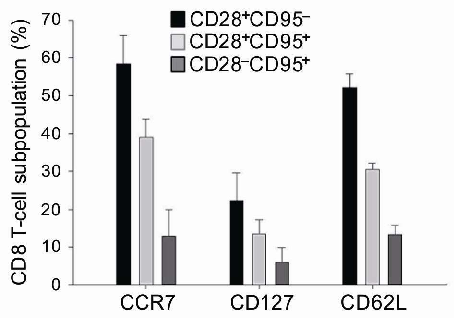
Figure 1
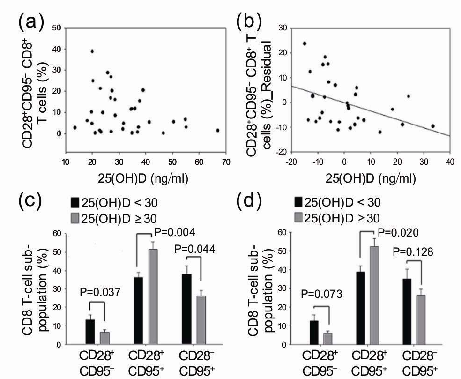
Correlation analysis between serum 25-hydroxyvitamin D levels and CD8 T cell subset distributions during early aging reveals that higher vitamin D is associated with decline of naive but accumulation of effector memory T cells.
chart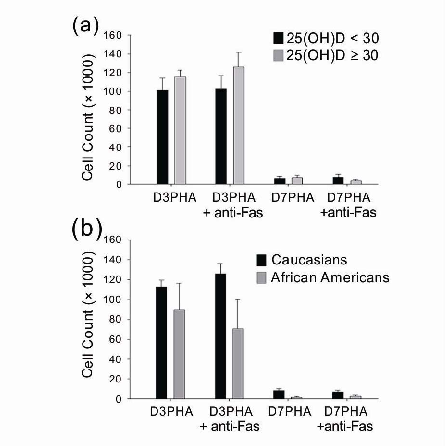
Figure 3
T cell proliferative responses and anti-Fas antibody-mediated suppression assays demonstrate that vitamin D status influences both proliferative capacity and apoptosis susceptibility of CD8 T cell subsets during aging.
chart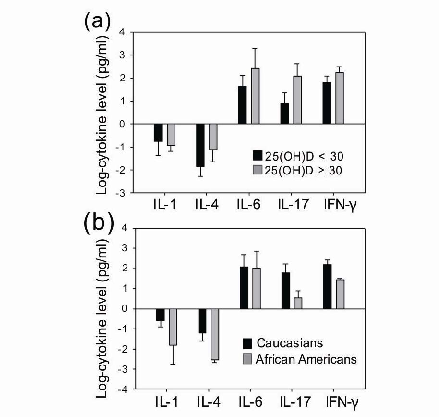
Figure 4
Cytokine levels (log-transformed) compared between 25(OH)D groups reveal differential inflammatory profiles associated with vitamin D status, with higher vitamin D linked to altered TNF-alpha and IFN-gamma production by CD8 T cells.
chartFigure 2
DiagramSource Paper
Increased vitamin D is associated with decline of naïve, but accumulation of effector, CD8 T cells during early aging.Cite This Figure
 > Source: Yong Gil Hwang et al. "Increased vitamin D is associated with decline of naïve, but accumulation of eff." *Advances in aging research*, 2013. PMID: [25392765](https://pubmed.ncbi.nlm.nih.gov/25392765/)
<figure>
  <img src="https://pdfs.citedhealth.com/figures/25392765/190.png" alt="Flow cytometry gating strategy and representative dot plots illustrate the identification of naive, central memory, effector memory, and terminally differentiated CD8 T cell subsets based on CD45RA and CCR7 expression." />
  <figcaption>Figure 2. Flow cytometry gating strategy and representative dot plots illustrate the identification of naive, central memory, effector memory, and terminally differentiated CD8 T cell subsets based on CD45RA and CCR7 expression.<br>  Source: Yong Gil Hwang et al. "Increased vitamin D is associated with decline of naïve, but accumulation of eff." <em>Advances in aging research</em>, 2013. PMID: <a href="https://pubmed.ncbi.nlm.nih.gov/25392765/">25392765</a></figcaption>
</figure>