ImmuneCited
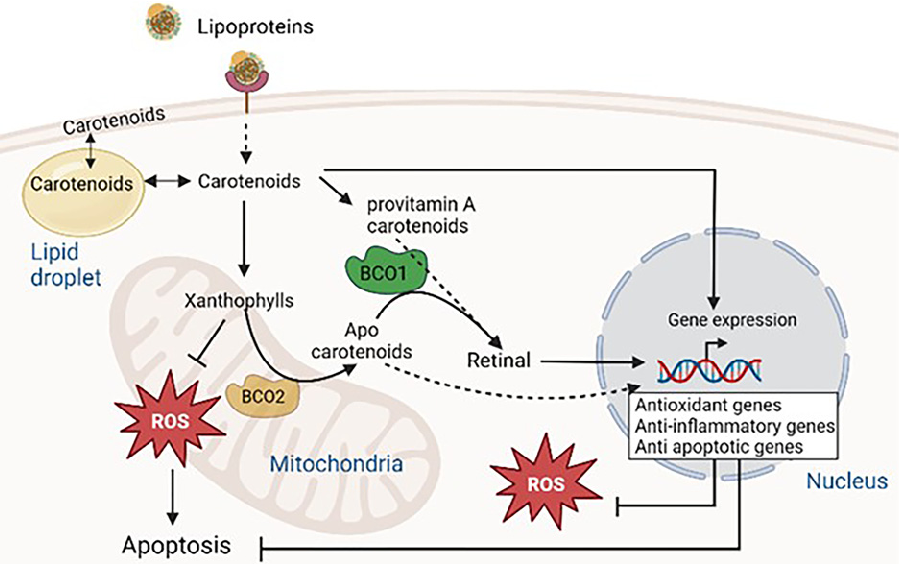
Figure 2. Overview of carotenoid metabolism with relevance to BCO1 and BCO2 enzymes. Carotenoids, found in circulating lipoproteins enter cells through distinct mechanisms involving various receptors and transporters, such as scavenger receptor class B ty
Figure 3. Figure 2. Overview of carotenoid metabolism with relevance to BCO1 and BCO2 enzymes. Carotenoids, found in circulating lipoproteins enter cells through distinct mechanisms involving various receptors and transporters, such as scavenger receptor class B type I, low-density lipoprotein receptor, CD36 membrane transporters, and lipoprotein lipase. Once inside the cells, carotenoids bind to carotenoid-binding proteins and become integrated into cytoplasmic lipid droplets, as well as plasma and mitochondrial membranes. Provitamin A type carotenoids such as β-carotene are symmetrically cleaved by β-carotene oxygenase 1 (BCO1) to yield retinal directly. Mitochondrial BCO2, on the other hand, asymmetrically cleaves carotenoids. The resulting carotenoid cleavage products (apo carotenoids) can be converted into retinal by BCO1. Carotenoids and retinal are transported to the cell nucleus and exert their influence on gene expression (antioxidant genes such as Nrf2 and ERK, anti-apoptotic genes such as Bcl-2 and anti-inflammatory genes) by interacting with nuclear receptors and transcription factors.

Descrição

Overview of carotenoid metabolism involving BCO1 and BCO2 enzymes. Carotenoids from circulating lipoproteins enter cells through scavenger receptor class B type I, LDL receptor, and CD36, undergoing enzymatic cleavage to produce retinoids and apocarotenoids with distinct biological activities.
Figure 3

Diagram
900 × 564px · 347,4 KB

Source Paper

Effects of carotenoids on mitochondrial dysfunction.

Biochemical Society transactions (2024)

PMID: 38385583

DOI: 10.1042/BST20230193

Cite This Figure

![Figure 3: Overview of carotenoid metabolism involving BCO1 and BCO2 enzymes. Carotenoids from circulating lipoproteins enter cells through scavenger receptor class B type I, LDL receptor, and CD36, undergoing enzymatic cleavage to produce retinoids and apocarotenoids with distinct biological activities.](https://pdfs.citedhealth.com/figures/38385583/96.png)

> Source: Opeyemi Stella Ademowo et al. "Effects of carotenoids on mitochondrial dysfunction.." *Biochemical Society transactions*, 2024. PMID: [38385583](https://pubmed.ncbi.nlm.nih.gov/38385583/)
<figure>
  <img src="https://pdfs.citedhealth.com/figures/38385583/96.png" alt="Overview of carotenoid metabolism involving BCO1 and BCO2 enzymes. Carotenoids from circulating lipoproteins enter cells through scavenger receptor class B type I, LDL receptor, and CD36, undergoing enzymatic cleavage to produce retinoids and apocarotenoids with distinct biological activities." />
  <figcaption>Figure 3. Overview of carotenoid metabolism involving BCO1 and BCO2 enzymes. Carotenoids from circulating lipoproteins enter cells through scavenger receptor class B type I, LDL receptor, and CD36, undergoing enzymatic cleavage to produce retinoids and apocarotenoids with distinct biological activities.<br>  Source: Opeyemi Stella Ademowo et al. "Effects of carotenoids on mitochondrial dysfunction.." <em>Biochemical Society transactions</em>, 2024. PMID: <a href="https://pubmed.ncbi.nlm.nih.gov/38385583/">38385583</a></figcaption>
</figure>
