
Figure 1
520 × 627px
· 283,3 KB
Source Paper
Lysosomal Stress in Cardiovascular Diseases: Therapeutic Potential of Cardiovascular Drugs and Future Directions.Cite This Figure
 > Source: Toshiki Otoda et al. "Lysosomal Stress in Cardiovascular Diseases: Therapeutic Potential of Cardiovasc." *Biomedicines*, 2025. PMID: [40426881](https://pubmed.ncbi.nlm.nih.gov/40426881/)
<figure>
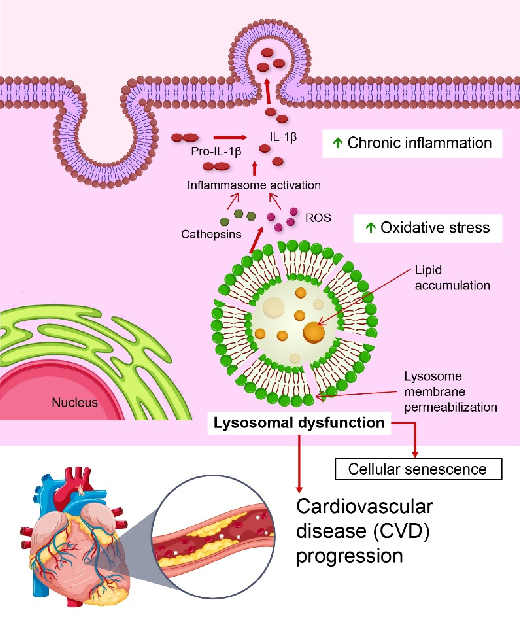
  <img src="https://pdfs.citedhealth.com/figures/40426881/112.png" alt="Figure 1. Role of lysosomal dysfunction in the progression of cardiovascular disease (CVD). Lysosomal dysfunction, characterized by lysosomal membrane permeabilization and lipid accumulation, leads to the release of cathepsins and reactive oxygen species " />
  <figcaption>Figure 1. Figure 1. Role of lysosomal dysfunction in the progression of cardiovascular disease (CVD). Lysosomal dysfunction, characterized by lysosomal membrane permeabilization and lipid accumulation, leads to the release of cathepsins and reactive oxygen species <br>  Source: Toshiki Otoda et al. "Lysosomal Stress in Cardiovascular Diseases: Therapeutic Potential of Cardiovasc." <em>Biomedicines</em>, 2025. PMID: <a href="https://pubmed.ncbi.nlm.nih.gov/40426881/">40426881</a></figcaption>
</figure>