Description
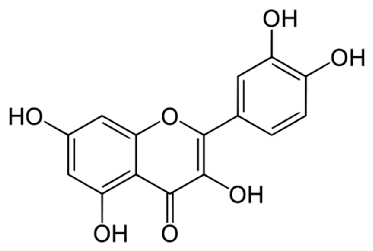
Chemical structure of quercetin (3,3',4',5,7-pentahydroxyflavone) is displayed, showing the hydroxyl groups on the flavonoid backbone that contribute to its antioxidant and anti-allergic properties.
Figure 5
Diagram
373 × 251px
· 15.0 KB
Source Paper
Quercetin and Its Anti-Allergic Immune Response.Cite This Figure
 > Source: Jiri Mlcek et al. "Quercetin and Its Anti-Allergic Immune Response.." *Molecules (Basel, Switzerland)*, 2016. PMID: [27187333](https://pubmed.ncbi.nlm.nih.gov/27187333/)
<figure>
  <img src="https://pdfs.citedhealth.com/figures/27187333/68.png" alt="Chemical structure of quercetin (3,3',4',5,7-pentahydroxyflavone) is displayed, showing the hydroxyl groups on the flavonoid backbone that contribute to its antioxidant and anti-allergic properties." />
  <figcaption>Figure 5. Chemical structure of quercetin (3,3',4',5,7-pentahydroxyflavone) is displayed, showing the hydroxyl groups on the flavonoid backbone that contribute to its antioxidant and anti-allergic properties.<br>  Source: Jiri Mlcek et al. "Quercetin and Its Anti-Allergic Immune Response.." <em>Molecules (Basel, Switzerland)</em>, 2016. PMID: <a href="https://pubmed.ncbi.nlm.nih.gov/27187333/">27187333</a></figcaption>
</figure>