Deskripsi
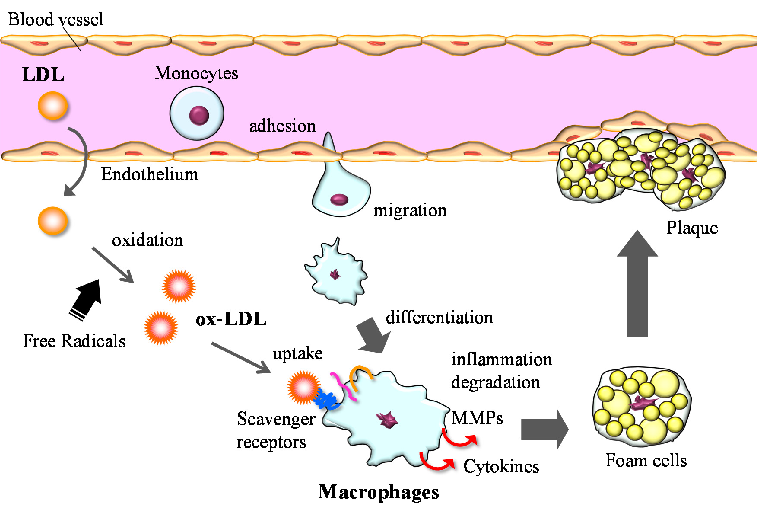
Macrophages play a central role in atherosclerosis development through uptake of oxidized LDL, foam cell formation, and secretion of inflammatory mediators. Astaxanthin may interrupt this process by reducing LDL oxidation and modulating macrophage activity.
Figure 6
Diagram
757 × 511px
· 175,3 KB
Source Paper
Potential Anti-Atherosclerotic Properties of Astaxanthin.Cite This Figure
 > Source: Yoshimi Kishimoto et al. "Potential Anti-Atherosclerotic Properties of Astaxanthin.." *Marine drugs*, 2016. PMID: [26861359](https://pubmed.ncbi.nlm.nih.gov/26861359/)
<figure>
  <img src="https://pdfs.citedhealth.com/figures/26861359/67.png" alt="Macrophages play a central role in atherosclerosis development through uptake of oxidized LDL, foam cell formation, and secretion of inflammatory mediators. Astaxanthin may interrupt this process by reducing LDL oxidation and modulating macrophage activity." />
  <figcaption>Figure 6. Macrophages play a central role in atherosclerosis development through uptake of oxidized LDL, foam cell formation, and secretion of inflammatory mediators. Astaxanthin may interrupt this process by reducing LDL oxidation and modulating macrophage activity.<br>  Source: Yoshimi Kishimoto et al. "Potential Anti-Atherosclerotic Properties of Astaxanthin.." <em>Marine drugs</em>, 2016. PMID: <a href="https://pubmed.ncbi.nlm.nih.gov/26861359/">26861359</a></figcaption>
</figure>